A completed author edition
The book is not a proof copy, temporary printout or unfinished prototype. It is a finished physical form issued by the author.
Ashraellen
Author-issued physical books / public book passports
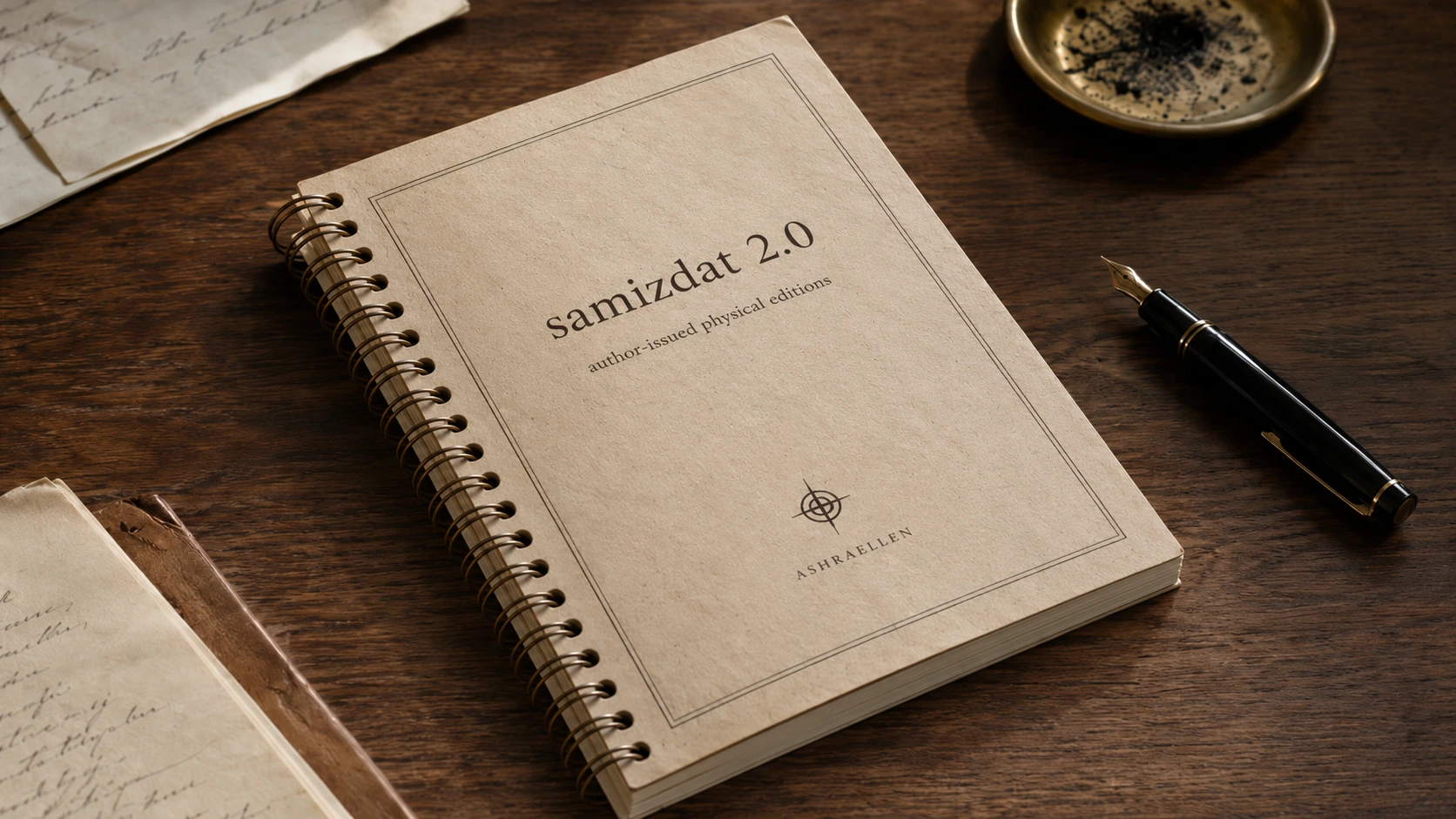
A book does not have to become an anonymous product in order to become public.
samizdat 2.0 is a contemporary structure for books completed by the author, given a physical form outside the industrial publishing chain, and transmitted directly to readers. Each edition remains connected to its origin through a permanent public passport.
publication is easy; presence is not
Classical samizdat appeared where a text could not pass through official channels. Today the technical act of publication has become almost universally available. A file can be released instantly, a book can be printed on demand, and a text can circulate without asking permission.
Yet this freedom creates another loss. The physical book is easily absorbed into the same anonymous circulation as every other product: generated, ordered, delivered and forgotten without a visible relation between author, object and reader.
samizdat 2.0 responds to that condition. It does not imitate clandestine publishing and does not romanticise scarcity. It restores a direct and accountable relation between the completed work, the author who gives it material form, and the particular copy that enters the world.
The point is not to escape publication. The point is to prevent the book from losing its origin when it becomes public.
not a draft, not a substitute
The book is not a proof copy, temporary printout or unfinished prototype. It is a finished physical form issued by the author.
The edition may exist without ISBN, warehouse stock, distributor or conventional print run. Its legitimacy comes from the completed work and the author’s declaration.
Each physical copy may be signed and individually numbered. The number marks its place in the author’s sequence, not artificial rarity.
A QR code connects the physical book to a stable online address containing the edition’s identity, construction, language and continuing history.
from manuscript to transmitted object
a trace of the object, not ownership of the reader
The individual number belongs first to the physical copy. It confirms that this object was completed within an authorial sequence and was not an unmarked duplicate detached from the edition.
A future record may preserve facts about the copy itself: its number, language, date of completion, place of transmission and author’s signature. Personal information about the reader is not a necessary condition of authenticity.
This distinction is essential. samizdat 2.0 creates memory without turning the owner into an object of compulsory registration.
one printed address / a living public record
The QR code inside the book does not lead to a download file or a shop page. It leads to a permanent entrance for that specific work.
Language versions, edition details, photographs, corrections and future historical notes can be added without replacing the printed code. Each new samizdat work receives its own permanent entrance and its own passport structure.
The physical book remains unchanged. The public context around it can continue to grow.
one reader choosing the next
Samizdat has always lived through circulation. A book was read, passed on, lent or given to someone for whom it might matter.
A numbered samizdat copy may remain with its reader for life. There is no obligation to surrender it. But if the reader wishes the book to continue its journey without parting with their own copy, another copy may be acquired and given to someone else.
This is not merely the purchase of a second object. It is a continuation of transmission: one reader choosing the next.
author editions currently present