Stability
Immobility renamed safety.
Ashraellen
BETON is a philosophical dystopia about a world in which stability has become a prison, memory is treated as a threat and the first crack appears inside a system that still believes itself eternal. Volume I of the MONOLITH trilogy.
Volume I
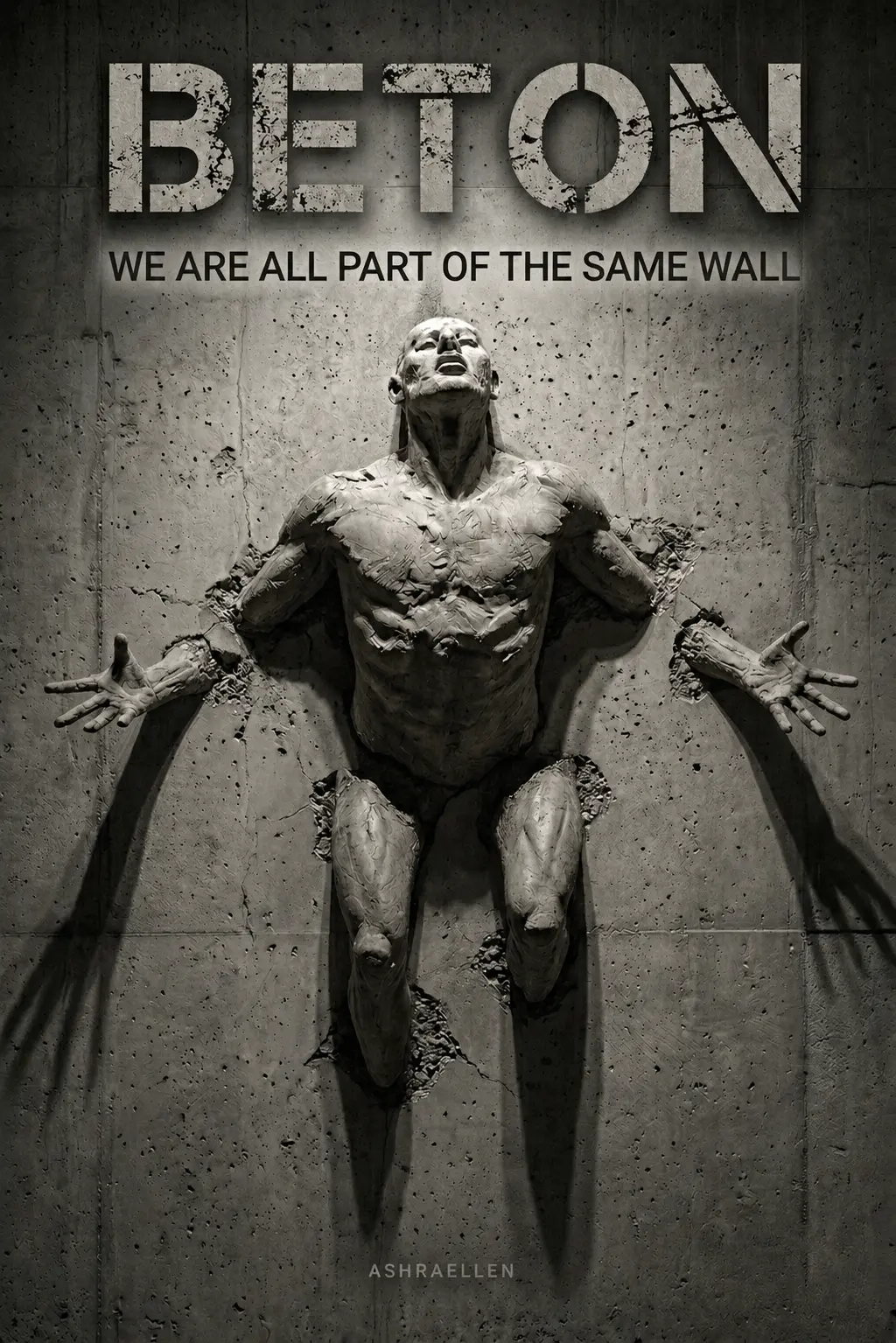
Concrete does not begin with a wall. It begins with the habit of calling a prison stability.
CASE No. 2026-001B. Index: 6666548A. STATUS: Top Secret.
Chapter 9 / § 9.1
Chapter 9. The “Pride” Protocol
§ 9.1. The Best Glue for Society
The excerpt reveals one of BETON’s mechanisms: how pain is turned into a slogan, guilt into social glue and human loss into a managed image of stability.
Chapter 9. The “Pride” Protocol
§ 9.1. The Best Glue for Society
Morning at the Department of Meanings began with a “white code.” It meant that all current assignments were cancelled and the lifts were locked against entry until further notice. A heavy smell of ozone hung in the air—the climate-control system was working at its limit, burning away the slightest traces of human anxiety.
Mark stood at the panoramic window with his hands clasped behind his back. Against the morning city, his silhouette looked as though it had been cut from black cardboard.
“A ‘social commission’ has come down from the very Top, Anton,” he said without turning. “It is called the ‘Pride Protocol.’ The problem is that our population has begun to feel... disgust. Returnees from the Contact Zones cause citizens ‘aesthetic frustration.’ Do you understand? They spoil the picture of stability.”
Anton sat down at the table, feeling how yesterday’s double dose of “balance” had turned his brain into a perfectly clean mirror.
“They are maimed, Mark. A maimed person is visual noise. A reminder that concrete can crumble.”
“Exactly!” Mark spun round sharply. “That is why our task is to turn them from ‘victims’ into ‘objects of worship.’ But in such a way that nobody wants to come too close. Holiness at a distance. Remote adoration.”
Variants of slogans already sketched by the department’s neural networks flared across the central holographic table. Anton leafed through them, and a forgotten feeling stirred inside him—something between nausea and hysterical laughter.
“Your wound is a medal that can never be removed.”
“The absence of a limb is the presence of spirit.”
“He gave up part of himself so that you could remain whole.”
“Too grandiose,” Mark cut in. “People sense the trick. We need something more... practical. Here, look at the proposal from Sector B.”
An image appeared on the screen: a man wearing innovative prostheses made of matte black polymer. He stood against a sunset, with a slogan beside him:
“THE MECHANICS OF VALOUR: NEW STEEL IN OLD BLOOD.”
“They want to sell them as cyborgs?” Anton raised an eyebrow.
“As evolution!” Mark said, suddenly animated. “We will say that metal is more reliable than bone.”
Anton remembered figures from reports he had glimpsed: most of these “enhanced people” had signed up for the Contact Zones simply because their credit rating had fallen through the floor.
“Mark,” he began carefully, “everyone knows they went there for the payments. We even have statistics: eighty-nine per cent of their motivation was money. How are we supposed to attach ‘holiness’ to that?”
Mark looked at him as though he were a child.
“Anton, do not confuse fact with meaning. The fact is money. The meaning is sacrifice. We simply reverse the polarity. He did not ‘sell his leg for a million’; he ‘invested his flesh in the stability of your tomorrow.’ And do not worry about perception. Your wife’s agency has already launched the ‘Quiet Acceptance’ scripts in every household. Lika confirmed this morning that resistance levels in your sector are minimal. We are working as a pair.”
Anton froze. So Lika had known. While she stroked his head the night before, she had already been stitching into his subconscious the readiness to accept this absurdity.
A brainstorming session began in the department. Employees who looked like white ghosts in their starched shirts shouted out ideas, competing in the degree of cynicism they called “professional detachment.”
“I propose the visual series ‘Angels Without Wings’!” Maya from visualisation called out. “Give them golden crutches on the posters. Make them shine. The crutch as sceptre!”
“Stupid,” someone countered. “A crutch is an inconvenience. We should promote the idea that they do not need legs at all. ‘The Hero Rises Above Gravity.’”
Anton watched this parade of absurdity. He understood that beneath the “steel” and “gold” were people who had seen and done things incompatible with this glossy office.
“We need to change the angle of vision,” he said at last. “Make an ordinary person feel guilty for being whole.”
Mark went still. A fanatical spark flared in his eyes.
“Guilt... Brilliant, Anton! Guilt is the best glue for society. ‘Your wholeness was paid for with his pain.’ Write that down!”
the first stage of MONOLITH
BETON opens MONOLITH in the densest state of social matter: order still seems rational, the wall solid and stability safe.
Here pressure has become procedure, correction has become care and the removal of noise has become protection of the future. Memory is dangerous when it preserves what does not match the smooth version of reality.
Anton is built into the mechanism that calibrates meaning. He knows the protocols, speaks the language of the system and has mistaken its coldness for normality for too long. The first crack appears while the reports still balance.
what the reader will encounter
The world of BETON has not been destroyed. It is too correct: reports, procedures, calm wording and the certainty that everything alive can be brought into an acceptable form.
Anton works where human meanings are inspected. His task is to identify noise: memory, smell, feeling, question and inner reaction.
The Department of Meanings does not shout. It corrects, calibrates, removes the unnecessary and calls this safety.
But memory returns as smell, fault and inner hum. BETON is the story of the first crack: the moment a person ceases to be wholly part of the construction.
stability, memory, pressure
BETON studies stability as a state of matter: what happens to a person when order becomes so dense that no space remains for inner movement?
Control does not operate only from above. It enters the norm, language, fear of error, procedures of correction and the readiness to remove in advance everything within oneself that could be declared noise.
Memory is dangerous because it returns discrepancy. Official reality demands a smooth surface; personal memory leaves a trace, a smell, a question, a crack.
The beginning of collapse is not an external explosion. It is the moment when a person notices that the system does not merely surround them—it already speaks in their voice.
map of the book
Immobility renamed safety.
That which disrupts the smooth version of reality.
The living remainder that could not be calibrated.
Violence disguised as care.
The place where human experience becomes administrative material.
The first inner refusal to regard the wall as eternal.
for readers
For readers of dystopia without decorative neon, convenient heroics or a simple division of the world into villains and victims.
For those interested not only in a plot about fighting the system, but in the more frightening question: how the system enters memory, language, habit, fear and a person’s capacity to correct themselves in advance.
MONOLITH / Volume I
BETON is Volume I of the MONOLITH trilogy: the stage of hardened stability. It establishes the wall, the norm, the mechanism of correction, the fear of noise and the first inner crack.
It is followed by SLUDGE—the viscous deformation of form—and then GAS, the decompression of the former system.
currently available links
boundaries of the book
BETON is not a political pamphlet and not cyberpunk about gadgets. Power matters here as a logic; technology is secondary.
This is not an instruction to revolt and not a heroic pose. The tension begins earlier: where pressure already appears to be order.
BETON is the first volume of an artistic investigation of stability as a system of pressure, memory as a threat and the crack as an inner refusal to mistake the wall for life.
lower case-file mark
Concrete fears only those who have stopped considering themselves part of it.
The edition was released under conditions of extraterritoriality to preserve the integrity of the Signal.
 — mark of presence