Viscosity
Movement that holds a person ever deeper inside the environment.
Ashraellen
SLUDGE is a philosophical dystopia about a world in which pressure no longer resembles a wall: it seeps into everyday life, language and the body, blurs boundaries and turns the human being into material of the environment. Volume II of the MONOLITH trilogy: viscous deformation, exhausted resistance and complicity as habit.
Volume II
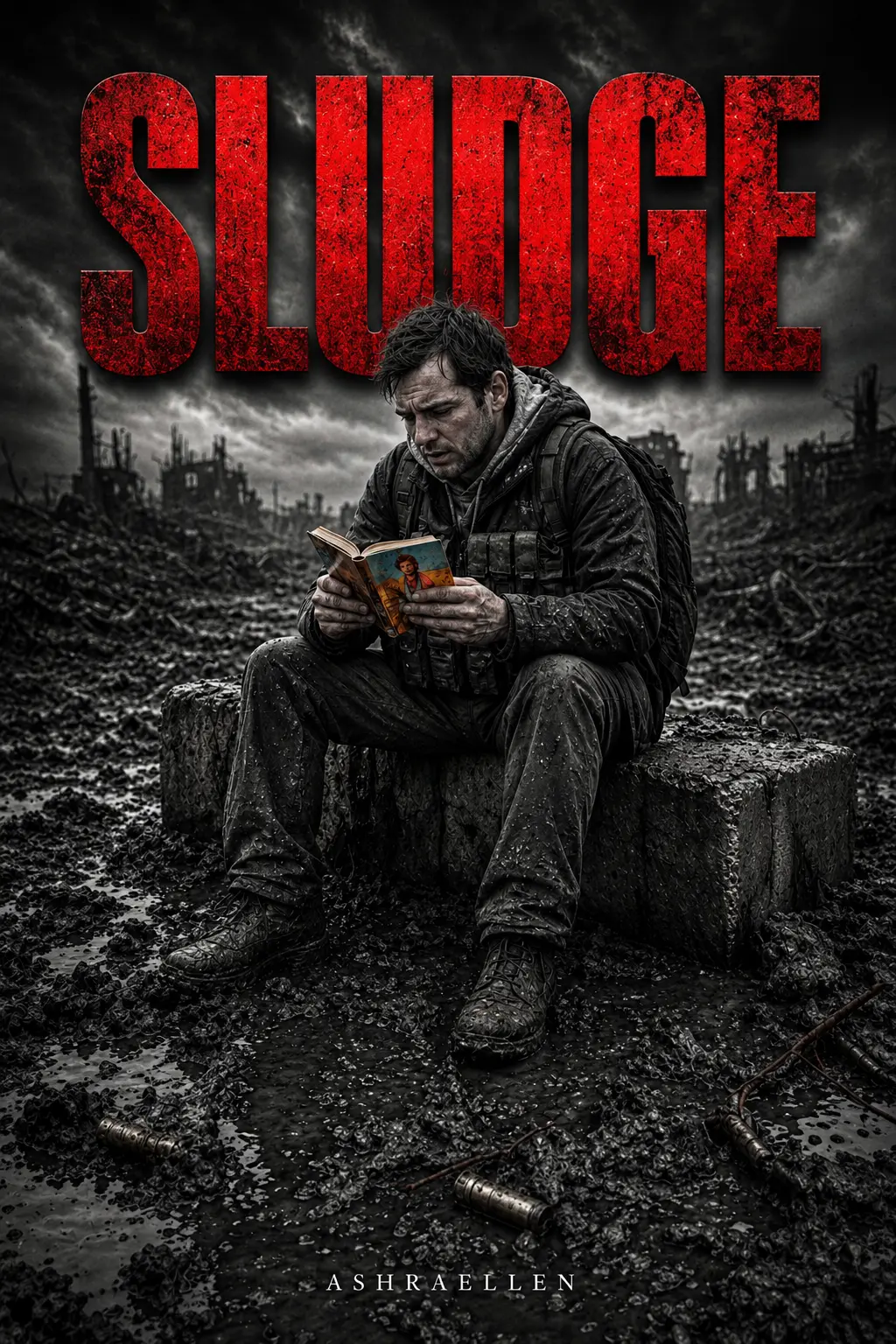
A person does not break all at once. First they grow tired of resisting. Then they begin to agree.
CASE No. 2026-001B. Index: 6666548A. STATUS: Top Secret.
Chapter 6 / § 6.2
Chapter 6. First Steps through Sludge.
§ 6.2. Warehouses for the Preservation of Shards
The excerpt shows how ordinary need, ritualised procedure, fear, silence and complicity become the everyday composition of SLUDGE.
Chapter 6. First Steps through Sludge.
§ 6.2. Warehouses for the Preservation of Shards
For breakfast they were given porridge. Not food in the human sense, but precisely porridge—grey, viscous, with that characteristic taste that appears when grain has been kept too long in a damp sack and then reheated not for satiety, but to fulfil a quota. It was ladled into identical metal bowls, and the steam carried no smell, only a shared warm reminder that biology had not yet been abolished completely. People ate in silence, quickly, without pleasure and without disgust. Adam ate too—not even from hunger, but because his body had already begun to act within the limits of what was provided. The spoon scraped the metal of the bowl, and that sound seemed almost domestic compared with everything surrounding them outside.
After breakfast, Segment No. 404 was formed into ranks and driven towards the hangars.
They stretched away from the main unloading line—long, concrete, low, with darkened seams and warped gates. Half-erased inscriptions still clung to signs that had partly pulled away from the wall, and above one entrance Adam managed to read the official designation: “Warehouses for the Preservation of Shards.”
The name was so exact that for a second it did not even register as an official substitution. Only then did he understand that here, as everywhere in MONOLITH, “preservation” meant not care, but a postponement of complete decay. And “shards” meant not objects, but everything that had already broken away from the system and could still be used again.
Grey-haired, walking beside him, gave a short snort when he noticed Adam reading the sign.
“You like it?” he asked. “A good place. Old imperial warehouses. Everything those who thought themselves cleverer than the system failed to remove is rotting here. Then MONOLITH comes along and calls it a resource again.”
Inside the hangar it was dim and damp, and it smelled of old iron, mould, oil and that peculiar warehouse dust which does not merely lie on things, but enters them, changing their temperature, weight and sound. Along the walls ran racks cluttered with boxes, bundles, tied straps, tarpaulin, helmets, boots, rusty fittings and incomplete sets of something that had once had a precise purpose and now existed only as a remainder of usefulness.
“One at a time!” Ork barked, and his voice travelled easily through the hangar as through an empty reservoir. “Collect your Instruments of Integration and protective equipment. Leave the resistance of the Ego on the platform!”
The last sentence drew a brief smirk from Kazik. Giena seemed not to hear it at all—his eyes were already reading the counter like a man for whom any warehouse automatically becomes a table of stock and shortage.
Adam was called among the first.
The storekeeper flung an Instrument of Argumentation into his hands.
It was heavier than it looked. Not with the pleasant, reassuring weight of a working weapon, but with the blunt, neglected heaviness of a thing left motionless for too long. The Instrument of Argumentation smelled of mould, old iron and machine oil that had long since ceased to protect anything. The barrel was mottled with reddish corrosion, like skin with an untreated disease. When Adam instinctively pulled the bolt, it answered with a hard, scraping clang, as though rusty wire really had been fitted inside in place of a spring.
“You’ll get ammunition in the Contact Zone,” the storekeeper threw out without looking at his face. The storekeeper’s own face was grey as ash after rain, and Adam understood at once: this was neither age nor illness, but the Cobweb, settled deeper in the man than his skin. “If you get there.”
Beside him, Kazik was already turning his own weapon over with almost childlike excitement. The mere fact of possessing an Instrument of Argumentation seemed enough for him. Curly silently checked the strap without even trying to assess the mechanism. For both of them, reliability mattered less than the form of admission. The act of issue itself granted them a new degree of right. You could see it in the way they held their shoulders, in how quickly they took on the object’s outline.
Next Adam was issued a bulletproof vest.
Issued was exactly what happened—not selected, not measured, not secured to fit. They simply threw into his hands a massive-looking vest covered in coarse synthetic fabric, with straps, fasteners and the factory-made appearance that could genuinely reassure an untrained eye. The vest was unexpectedly light. That was precisely what made it convincing. It looked serious, solid, protective, yet weighed as if some new, expensive material had been used inside it.
Adam involuntarily held it a little longer. Tightened the straps. Pulled it on. The coarse fabric settled over his chest, and for an instant he felt the almost shameful sensation that he had finally been assembled, drawn together, given at least some form of protection. The illusion lasted only a second, but it had time to work. That was why the blow went deeper.
The former part of him—the part that still remembered standards, specifications, logistics tables and miracle reports about new developments for “New Steel”—worked faster than experience. He felt the edge of the vest, registered its thickness and said, turning to Grey-haired:
“Look. At least they took care of us here. Thick, isn’t it? Probably the latest development.”
Grey-haired, who was squatting by the wall trying to rub dirt from the stock of his rusty Instrument of Argumentation, first went still. Then he breathed out shortly and dryly through his teeth, as though he had heard not naivety but an old joke of the system, far too familiar to him.
Only then did he begin to laugh.
His laughter was dry and barking, breaking into a cough. The sound chilled Adam more deeply than any shouted order.
“Took care of us?” Grey-haired repeated, slowly rising. “The system cares only about the airtightness of its reports, manager. Not about your soft belly. Give it here.”
He came right up to him without asking permission. He smelled of dust, iron and the already familiar dry exhaustion of a man who had seen the same thing too many times in different scenery. In his hand was a knife—not military, not special, but an old shard of reinforcing bar sharpened to a shine, turned into a tool by the same principle through which everything here was turned from one thing into another.
With one quick movement he slit open the side seam of the plate pocket.
An object fell from the cut with a quiet, almost wooden knock.
It dropped at Adam’s feet, rolled and came to rest in the Sludge by the entrance.
It was an ordinary pine board. Thick, roughly sawn, slightly damp from the common air, with traces of the factory marking of a furniture plant in the Far Sector. Blue paint was still visible on one end, and along the grain ran a fresh, almost homely pattern of wood.
For a while, no one spoke.
Even Kazik stopped fiddling with the straps. Even Giena raised his head from his calculations.
Grey-haired nudged the board with the toe of his boot, then picked it up, tossed it once in his palm and threw it back into the Sludge.
“There’s your protection, Adam,” he said. “On the outside, you’re a hero of the ‘Pride’ Protocol. Inside, you’re empty space covered with firewood.”
The board slowly settled into the grey-brown mass by the gates, half submerged and half left in view, like material evidence that MONOLITH lied not allegorically, but materially.
Adam stared at it, unable to reconcile the vest’s thickness, its light weight and that piece of cheap wood inside. The deception was too simple, almost rustic, and therefore especially destructive. There was not even any sophisticated technology of lying behind it—only the brazen certainty that the material would not open its own protection before the first hit.
“But how...” he said quietly. “How are we supposed to go into Contact wearing this?”
Grey-haired had already bent over his rusty Instrument of Argumentation again.
“Don’t whine,” he cut him off. “Want to live—write to your mother in the Lower Sector. Let her sell her housing unit, take out a loan at four hundred per cent from the Department of Balance and send you a proper plate by Special Transport courier. Everything is simple here: the system does not give you a resource. It makes you and your own people pay for your disposal. The highest form of enslavement is when you buy your own coffin so MONOLITH does not have to spend money on your concrete.”
These words, like everything Grey-haired said, did not sound like a sermon. He was not trying to impress anyone. He simply spoke as a man for whom the mechanism had long ago opened down to its last screw, so that even its most monstrous parts could be described as dryly as another man might describe plumbing.
Kazik and Curly were already trying on their shells without even looking inside. For them, the very possession of a “uniform” was an initiation. Protection did not interest them. They wanted what came with the uniform: right, status, belonging to a new category, the ability to address someone weaker not as a person, but as an element of the process.
Giena, by contrast, crouched by the wall and, frowning, felt his plate through the fabric.
“Mine is wood too,” he said almost calmly. “Only thinner.”
“Be glad,” Grey-haired replied. “Statistically, it means you’ll be slightly cheaper to kill.”
Adam did not answer. He looked at the opened vest in his hands, at the dangling straps, at the empty internal space into which one could put a board, rags, air—anything, so long as from the outside it looked like protection.
And at that moment he understood that everything here really was built on the same principle: function on the outside, substitution within.
The outline looked like transport, but was packaging. A preservation cell sounded like care, but was a postponement of decay. The vest looked like protection, but was a visual protocol for subsequent trust. Even their own life here would probably look like service, while in essence it would be only properly documented disposal.
Outside the hangar someone was shouting, other segments called back and forth, iron clanged, and all of it sounded like an enormous sorting station where materials pass through different sections before final processing. In this mechanism there was no longer room for a human being, only for the image of a human being required by the report.
Adam involuntarily checked his pocket. The terminal was vibrating. The “settling-in allowance” had indeed reached his balance—a pitiful fraction of what had been stated in the contract he had “signed” under the influence of the Cobweb. In the Lower Sector it would have been a great deal of money. Here, among rusty Instruments of Argumentation, boards in bulletproof vests and Sludge by the gates, the figures already looked like mockery.
Grey-haired noticed the movement.
“Don’t even start calculating now,” he said without raising his head. “Otherwise the market will devour you faster than Contact.”
Adam looked up.
“What market?”
Grey-haired smirked.
“The one where people buy their last illusions with their own settling-in allowance. You’ll see when you get there. They’ll sell you communication, a plate, hope and a piece of clean cloth for the funeral report. Everything at the price of your fear.”
That sentence already opened the next stage.
But now, in the hangar, what mattered most was not the market or the future choice, but the board sinking into the Sludge by the entrance.
Because it was that cheap pine plate which for the first time gave Adam not an image of deception, but its substance.
And that was worse than any words.
the second stage of MONOLITH
SLUDGE begins after the first crack. The wall loses its rigidity, but freedom does not arrive: pressure becomes an environment, softens boundaries and makes participation more habitual than resistance.
At the centre is Adam, who has lost his work, home and former supports. His personal fall proves to be part of a process in which the human self is converted into a resource and material of the environment.
This is Volume II of MONOLITH: the viscous zone between solidity and decompression, through which nobody can pass clean.
what the reader will encounter
Adam loses his work, home and previous support. His life does not collapse in a single blow; it slowly comes apart at the seams.
Temporary spaces, other people’s rules, hunger, fatigue, ritual and false calm turn separate concessions into a change in the composition of the person.
In SLUDGE, violence works through habituation. A person is not broken at once; they are led towards a state in which disagreement becomes too heavy.
environment, fatigue, loss of boundaries
SLUDGE studies pressure that has become an environment. Resistance is not destroyed at once—it is spent through fatigue, hunger, dependence, repetition and false care.
Viscosity creates an illusion of movement: a person still chooses, but the choice already takes place inside an environment that has altered their boundaries.
The book’s main object is the moment when participation precedes consent and the environment begins to speak in the person’s voice.
composition of the environment
Movement that holds a person ever deeper inside the environment.
Resistance made too expensive.
Necessity translated into consent.
Repetition that turns the unacceptable into a norm.
Participation that began before consent.
The disappearance of the boundary between person and environment.
for readers
For readers of dystopia and psychological thrillers who care not only about open conflict with a system, but also about the quieter process: fatigue, habituation, dissolving boundaries and participation in what recently seemed impossible.
For those interested in stories without convenient heroics or a clear line between external violence and internal consent. SLUDGE works where a person still considers themselves separate although the environment has already changed their composition.
MONOLITH / Volume II
SLUDGE is Volume II of MONOLITH and the stage of viscous deformation. BETON establishes the wall and first crack; SLUDGE shows how pressure then becomes an environment, resistance tires and complicity enters habit.
This is not liberation after the collapse of solid order. SLUDGE lies between BETON and GAS: former boundaries no longer protect, but the complete decompression of form has not yet arrived.
currently available links
boundaries of the book
SLUDGE is not a story of liberation after the wall collapses. The loss of solid form does not mean freedom: control can move closer when it becomes an environment.
It is not only a story of personal downfall and not an instruction manual for resistance. The book studies a logic that works through vulnerability, fatigue, necessity, ritual, habituation and gradual participation.
SLUDGE is not a political pamphlet or cyberpunk about technology. It is the second volume of an artistic investigation into pressure that changes its state of matter and begins to act as the substance of everyday life.
lower case-file mark
While a person is solid, they protect only their form. When form begins to come apart, what they are made of becomes visible.
The edition was released under conditions of extraterritoriality as a continuation of the Signal first recorded in Volume I, object No. 2026-001B.
 — mark of presence